We endorse Wesam Shahed for Cook County Board District 6.
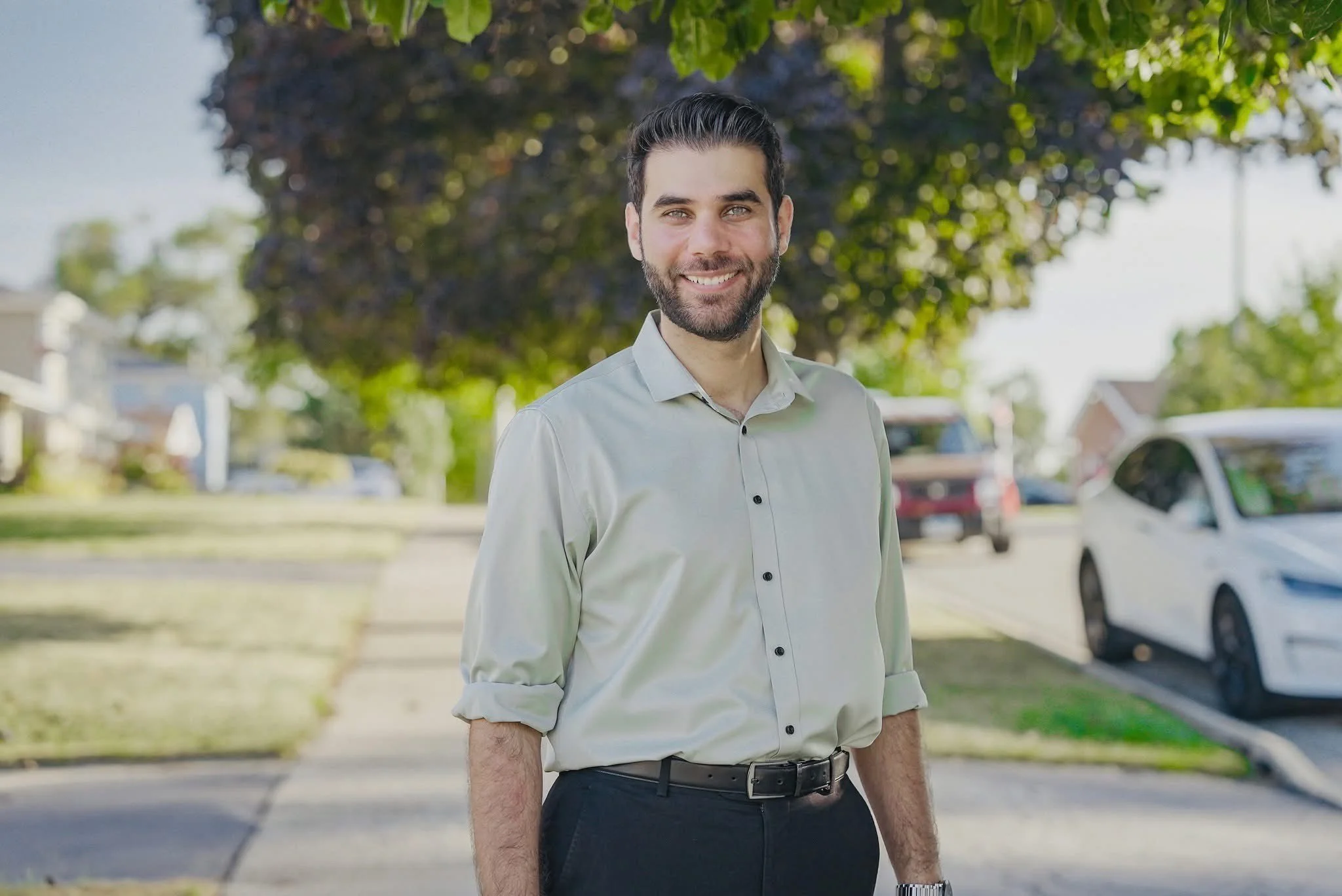
Born and raised in The Southland, Wesam Shahed’s district represents one of the most car-centric in the county and faces a disproportionate amount of the region’s truck traffic. As Wesam says, “that’s why I talk about transit justice and environmental justice together: we need better buses and trains, safer streets for people walking and biking, and a freight strategy that routes the heaviest trucks away from homes, schools and parks.”
Wesam is an experienced policy-maker who is ready to bring more holistic transit systems to Cook County District 6.
Read Wesam’s responses to our questionnaire
What types of transportation do you use during an average week, and how has this shaped your view of transportation policy?
In a typical week, I drive like most Southland residents, but I also use Metra, CTA, and Pace when I’m traveling into the city or around the region, and I walk a lot between meetings, doors and transit stops. Living and organizing in a part of the county that is deeply car-dependent, with spotty transit and unsafe streets for people walking and biking, has convinced me that our transportation system has been designed to move cars, not people. We need to flip that: prioritize safe walking and biking, reliable bus and rail service and low-carbon options so that driving becomes one option among many and not the only one.
What are some transportation challenges in your district?
District 6 faces all the classic Southland transportation challenges: infrequent transit service, long and expensive commutes to jobs, dangerous high-speed arterials and sidewalks or crosswalks that simply disappear. On top of that, we shoulder a disproportionate share of the region’s truck traffic, with heavy vehicles cutting through residential and commercial corridors, adding to crashes, pollution and noise. Many residents tell me they feel like prisoners to their cars; if you don’t drive, or your car breaks down, it’s hard to get to work, school or a doctor’s appointment. That’s why I talk about transit justice and environmental justice together: we need better buses and trains, safer streets for people walking and biking and a freight strategy that routes the heaviest trucks away from homes, schools and parks. Also flooding has been an issue in cities like Homewood/Flossmoor.
Cook County residents often find their local roadways fall under multiple different jurisdictions and standards. How do you view the County’s role in ensuring consistent, safe, and accessible transportation for constituents?
The County has to act as a convener and standard-setter. Residents don’t care whether a dangerous intersection belongs to IDOT, a township or a municipality. They just want it fixed. As commissioner, I’ll push Cook County DOT and Highways to tie our funding and technical assistance to clear safety and equity standards: Vision Zero goals, complete streets design, ADA-accessible sidewalks and bus stops and serious freight routing that keeps trucks out of sensitive corridors. The County should use its capital program and planning tools to knit together fractured jurisdictions, so people experience a continuous, safe network instead of a patchwork of rules and road conditions.
What can Cook County do to stabilize and expand access to bikeshare programs that span municipalities?
Cook County can be the backbone of a regional bikeshare system that actually reaches the South and Southwest suburbs. That means dedicating county dollars for multi-year bikeshare support, helping negotiate intergovernmental agreements so small municipalities aren’t left to figure it out alone, and targeting station locations near transit, schools, libraries and job centers. I support subsidized memberships and cash-based sign-ups for low-income riders and undocumented residents, and pairing bikeshare expansion with investments in protected bike lanes, traffic calming and safer crossings. This can be especially impactful in communities that have been ignored for decades. Bikeshare should be treated as part of our transit network rather than as a boutique amenity.
What role can the County play in bringing funding sources and revenue streams to county transportation projects?
Commissioners have two big jobs here: fighting for smart, progressive revenue and making sure we leave no outside dollar on the table. I will support progressive revenue options so we’re not relying on regressive fines or property taxes to fund transportation. At the same time, I’ll work with the President’s Office, CMAP and local governments to aggressively pursue state and federal grants under the infrastructure law and climate programs, and to align our capital plan with those opportunities. The County Board should also be transparent with residents about how transportation dollars are spent, so people can see investments flowing into long-neglected Southland communities.
Cook County has a history of innovating access to public services, including public transit – such as the Fair Transit South Cook pilot. As commissioner, what are ways you envision the County innovating on transportation?
Fair Transit South Cook was an important start; now we need to make that kind of innovation permanent and broader. I’d like to see the County work toward integrated, reduced-fare or fare-capping across Metra, CTA and Pace, expand frequent all-day service on key bus and rail corridors and develop on-demand microtransit options in lower-density areas where fixed-route service doesn’t yet work. We should also invest in “mobility hubs” that bring together transit, bikeshare, EV charging and safe walking routes, especially around job centers, hospitals and schools in the Southland. And every innovation should be measured against clear climate and equity metrics: cutting emissions, shortening commutes and improving access to opportunity for Black, Brown, immigrant and working-class communities that have been left behind.